After having taught twice in the African country of Malawi and then last year in Togo, I was ready to continue teaching in Africa. The next opportunity presented to me was to teach in Liberia, another country in West Africa.
Liberia has a unique history. The country was designated as a place for freed American slaves to return to in Africa if they so desired. Some did. Unfortunately they created an elite society that showed an unwillingness to participate in life with the Africans already living in the area. Eventually the tension came to a head, and war broke out and lasted far too long. It was only at the beginning of this century that the country chose a democratically elected president. The effects of the long years of war can still be seen and felt in the country.
The church leaders asked me to come and teach a course in church history for a week in early August. Preparing for the course was a daunting task, but I finally finished the week before I was to leave. Although my flight from Chicago was delayed, I made it through and eventually landed in Monrovia, the capital of Liberia. From the airport it was an hour to the hotel I would call home for the next nine days.
When I taught in Malawi and Togo, I had a place to stay on the campus of the school where I was teaching. That would not be the case in Liberia. There was no school campus which meant there was no housing for me to stay in. I stayed in a hotel near the downtown area of Monrovia. However, the church that was hosting the class I was teaching was some distance away. Each day a driver would pick me up from my hotel and drive me to the church and back. The drive was generally 45 to 50 minutes long. It was during those drives that I observed life in Liberia.
One of the things I noted was the roads. The country has some very nice 4 lane highways that are generally easy to drive on. However, watch out for potholes! Potholes in Liberia can be quite large, even car sized. Because it was the rainy season, most of them had filled with muddy water. As a result I didn’t know how deep these potholes were. The drivers learned pretty quickly about the potholes and how to drive through or around them in the most efficient manner. However, traffic would slow significantly near the largest potholes.


Dirt roads were another matter. Once one left the paved roads, the dirt roads were quite difficult to drive. Since it was the rainy season, the mud could be quite slippery. My first Sunday there, we drove to a church out in the countryside. We came to a small hill, and it took three tries before we managed to make it up the muddy hill. Deep ruts in the road can also add to the challenge of passing over the road.


Transportation on these roads comes in a variety of forms. Of course there are cars. Cars are not always in the best mechanical shape. It would not be unusual for a car to drive by spewing a cloud of blue smoke.
Motorcycles are quite common. They are a little easier to drive over the potholed and slippery dirt roads as one can find the narrow trail through it all. Many young people had motorcycles. While some individuals used them for personal use, others used them as a taxi form of transportation. One might see a motorcycle with as many as three passengers behind the driver. In an unusual twist for the motorcycles, many users had constructed an umbrella over them in order to minimize getting wet in the rainy season. This was a new one for me. On the negative side, unlike Togo, the law does not require drivers to wear a helmet so very few do so.


Then there are the kekehs. Kekehs are three wheeled vehicles used as a taxi service in the area. They provide a little more protection from the elements, especially during the rainy season. Drivers sometimes supplement the sides with more plastic sheets. One of my favorite things about kekehs is they will write slogans or signs on the back of their vehicles. Some of them are very obviously religious in nature.


Kekehs can not go everywhere, however. I noticed there were none on the road in front of my hotel. I’m not sure exactly where the boundaries are for using them, but there are definitely places they cannot drive.
Trucks are another vehicle on the roadways. They come in a variety of sizes. Rather than hauling people around they haul various products. Drivers often cover their cargo with large, colorful tarps to keep it dry.


Like many other countries, traffic laws appear to be more of a suggestion. The horn becomes the main way to travel over the roads. Lane lines mean very little. Vehicles will travel all over the roads to avoid those treacherous potholes. They will also cross the yellow center line and form another line of traffic in that lane going the opposite directions than it was intended.
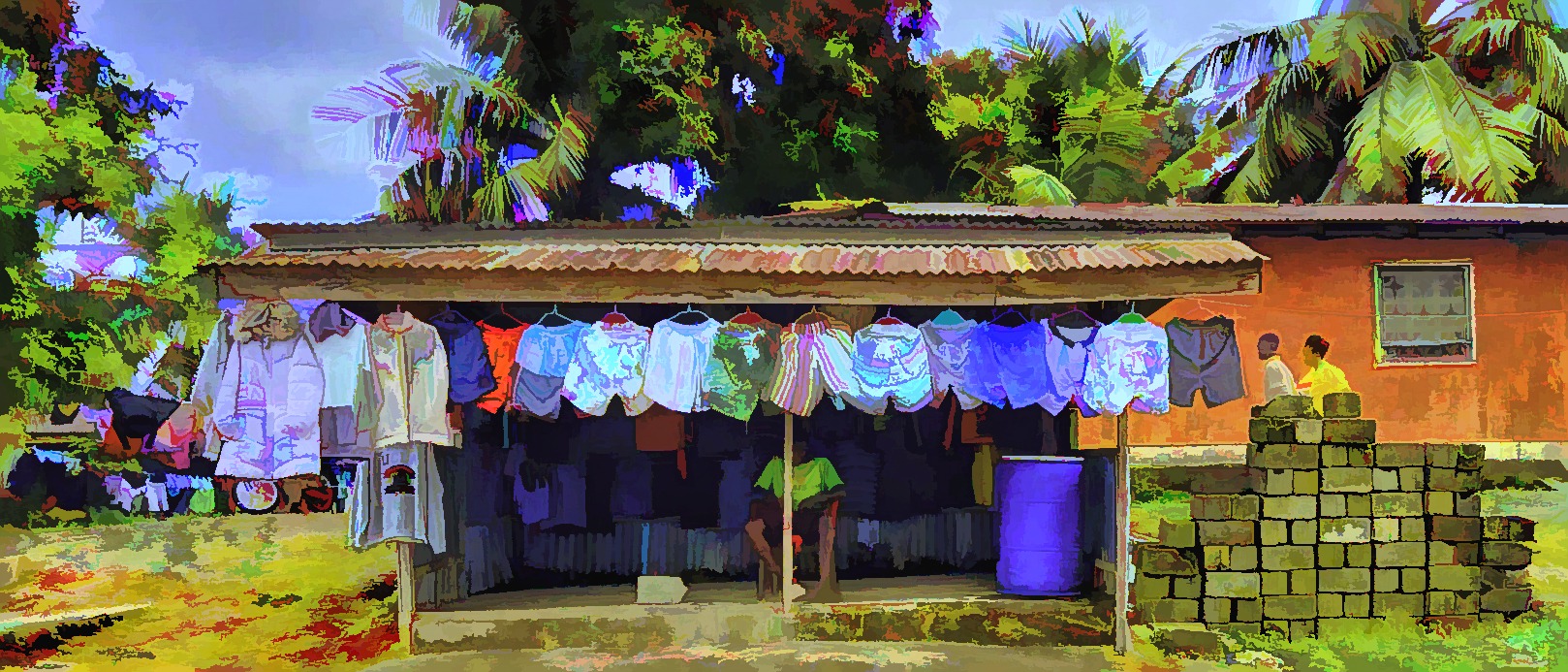
From a car window I could also see the entrepreneurial spirit of the people. Liberia is a poor country. The people are always looking for a way to make money. All along the roads are shops and roadside stands trying to sell everything from gasoline to used clothing along with fruits and vegetables. Some areas near major intersections seemed very full of people hawking their wares. Vendors will even come into the street to try to find a buyer when cars stop.


Of course there are other shops in buildings and even strip malls along the roads. Sadly it seemed everything was old and somewhat dingy. New construction is going up in places, but they are made of grey concrete blocks so they add no sense of newness to the city landscape.


The people I saw in the streets seemed disproportionately young. One statistic I saw was that the median age is 18.8 years old. In contrast to the United States, only 3% of the population is 65 or older.The challenge is finding employment for these young people.


There is a Muslim population in the area, but I only saw a few women wearing a head scarf so the Muslim population may be more pronounced in other areas of the country.
Drugs seems to be a problem in Liberia. One morning the hotel maid indicated I should look out my window. On the street below there was a “Just Say No to Drugs” march going on. Marchers wore mostly black and were marching to protest people using drugs. It was a pretty large demonstration. Unfortunately the marchers blocked traffic going into town. That impacted us as we left for the church. it took about 20 minutes longer than usual to arrive at the church.

One of the things my driver warned me about is to be careful using my phone camera out the window. The concern was that someone would come by and grab it out of my hands. That happened to the teenage son of the leader of the church. Men on a motorcycle drove by him and grabbed his phone. He was devastated by it as he used his phone a lot.
Liberia is a country with a lot of challenges ahead. Viewing the life of a country from a car window offers an incomplete picture of what life is like there. However, having driven the same road for seven days, I feel I did get at least some understanding of this African land. Unfortunately that picture is one of challenge and difficulty. The road ahead for Liberia will be full of bumps and turns. For the sake of its people, I hope the future will be increasingly brighter and smoother.
Discover more from Battered Suitcase
Subscribe to get the latest posts sent to your email.