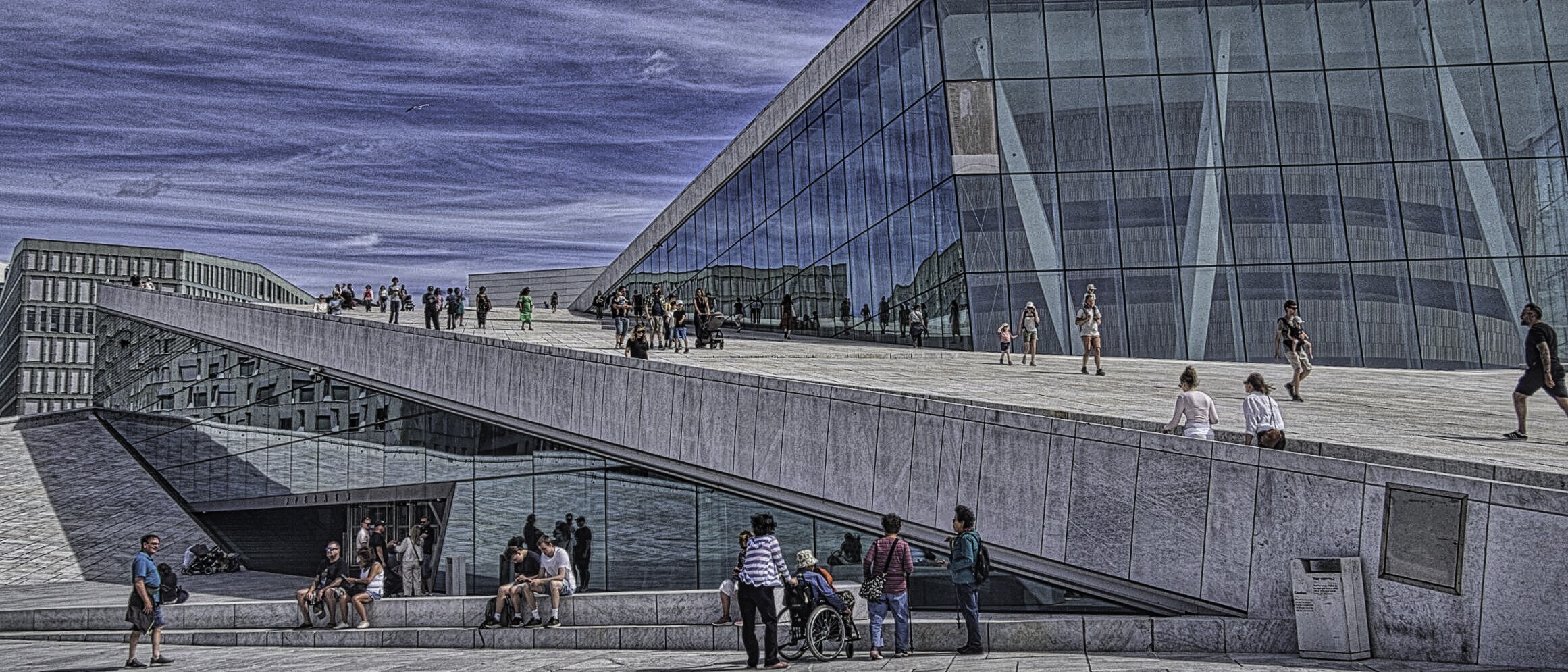
Since we arrived in Oslo, Norway late at night, we had not prepared to explore the city as we should have. We sort of just wandered around the first day. However, in the process we discovered a number of interesting aspects to the capitol city of Norway.
We weren’t quite sure where to start our exploration so we just left our hotel and started walking. Of course one of the first places we encountered was a church. It had a very tall steeple and looked to be quite old. We checked around the front, and the door was open. Inside was a fairly simple sanctuary. It was obviously not a Catholic church. It was the Grønland Norwegian Lutheran Church which had been built in the late 1860s. Inside we saw members who looked like they were setting up for an event so we didn’t linger.


I had put on the map search “old town Oslo,” and it looked like we were indeed following in that direction so we kept going. We came across another religious location which was Catholic. A sign indicated it was the location of an old monastery. We could see the remains of the old building. A newer building next to the ruins seemed to be some sort of religious center. Across the street was a community area with various activities. Farther along we came to an old brick building which a sign indicated was an Ethiopian Orthodox Church.


We continued across a river, and the map led us through a cemetery to a spot that the map indicated was old Oslo. We didn’t see anything of interest around this location that looked like old Oslo except for a nearby hospital. It had a number of buildings, some with dates which indicated they were quite old. Construction work was going on around it so we didn’t explore these buildings further.


We started to walk toward the city center when we passed near a hillside with a trail going up. After some discussion we decided to walk this trail. This was a major city park, Ekebergparken. Unfortunately the trail really did climb up the hillside including some sections with stairs. We persevered and made it to the top. A couple of viewpoints were available for people to check out the views below of the city and waterfront.


One aspect of Ekebergparken is seeing various art pieces which show up in the lanscape. We saw some interesting pieces that we felt didn’t quite belong in a family public park. Of course we didn’t see all the art as we didn’t go through the whole park. The park emphasizes international art works.


Having walked through the park, we took a road down to the bottom of the hill. No sidewalk existed so we just walked down the lightly used road. At the bottom was another unique art piece of containers. It reminded me of a piece we saw in Kaohsiung, Taiwan. The artist had use containers for that one as well.. We came to a major road into town and walked along a path which was probably intended to be a bicycle lane. Eventually we got off the lane and ended up at a park near a lake which was quite a serene place.


We now found ourselves near the waterfront, but being quite thirsty, we first stopped at a juice bar to rehydrate. We then continued on to the Opera House. This was indeed a unique structure. Ramps extended down the side of the building which allowed visitors to walk all the way up to the roof of the building. This gave views of a number of places around the waterfront, We were also able to go inside the Opera House, but just the foyer area where they had a cafe and restrooms.


One of the other important buildings on the waterfront is a building dedicated to the art work of one man, Edvard Munch. The Munch Museum is dedicated to the work of this modernist painter. We did not go into the museum, but the building itself is a bold statement on the waterfront. Near the museum sits a very large statue called Moren (The Mother). We did walk over to check it out more closely when we came off of the roof. It didn’t strike me as a very motherly image.


From the top of the Opera House we could also see the waterfront. A small beach-like area was full of sun seekers on this warm day. In front of the beach in the water is another unusual art piece. Made of stainless steel and glass, the structure has the feeling of a ship that is leaning to one side. The structure is called “She Lies” and is a permanent piece in the water.
Another interesting thing I observed across the street from the Opera house were three tall buildings which seemed unrelated to each other. However, all were nearly the same light green color on the exterior. I wondered if someone planned it that way.


At this point it was nap time so we wandered back to our hotel for a rest period. After finding a Mexican place for dinner, we planned to go to a large park in Oslo for the evening which has some interesting statues. However, we were having trouble figuring out how to get tickets for the light rail to take us there. We couldn’t find any ticket machines at the train station. Someone told us to use the app, but that didn’t cooperate with us either. We finally gave up and decided we would go tomorrow. After eating some ice cream, we returned to our hotel. We looked forward to a better day tomorrow.
Being in Oslo was quite a departure from our time on the cruise ship. However, it was good to get out and spend most of the day walking around. Learn more about Oslo next week. Until then have a great week and enjoy the journey.
Discover more from Battered Suitcase
Subscribe to get the latest posts sent to your email.