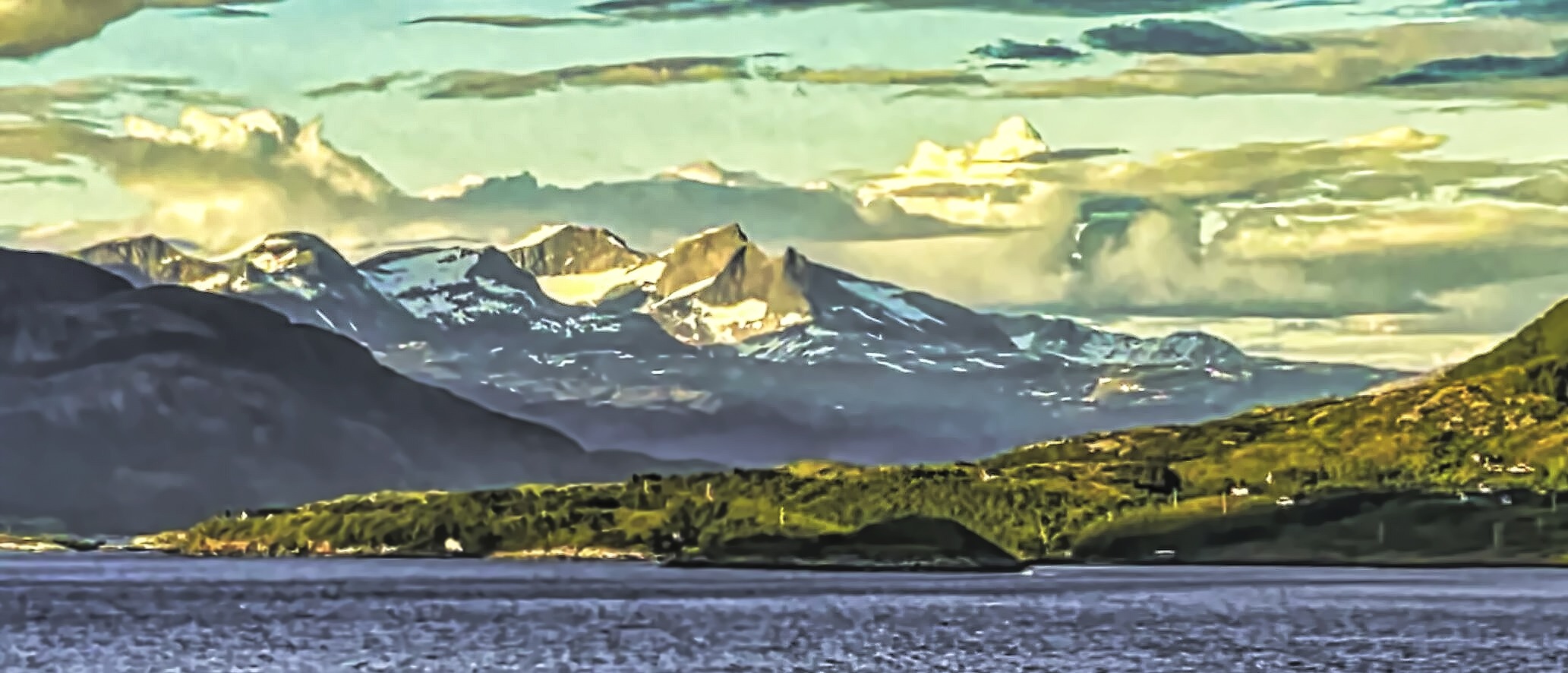
As we traveled our way north up the Norwegian coast, we continued to encounter beautiful scenery at every turn. Today we passed a number of significant points of interest before we finally had an opportunity to disembark from the ship in Treina (Træna). When we arrived in Treina, we were ready to get out and move. Our day ended crossing the Arctic Circle and experiencing the midnight sun.
The morning began fairly early at about 8:00 when a crowd began to gather on the top deck in anticipation of seeing the unique hole in the rock. Before the hole appeared, a staff member told both the folklore about the hole in the rock and the geological perspective. Unfortunately the wind made it hard for me to hear, but the folklore of the hole seems to center around a troll who was rejected by a beautiful woman he had fallen in love with. Geologically, the hole seems to be related to wave action.


We could see the large rock which had the hole long before we could see the hole.The ship slowed down as we passed making the wait even longer. Finally the hole became visible. It didn’t seem all that large from a distance, but the staff told us it was 40 meters by 120 meters. It is a rather unique point of interest. While we didn’t stop here, it is possible to hike to the hole.


Later in the morning we came across the second point of interest for the day, the Seven Sisters Mountains. The Seven Sisters is a series of rock structures that jut out from the base. Two jut out from opposite sides of the rock making them seem like twins, but they are counted separately. An even larger crowd gathered for the presentation of this site. The staff member related a long folklore story about the seven women involved in the mountain. I couldn’t hear much, but once again love seemed to be a part of the story.
We sailed very slowly by the formation. At times it seemed too slow. The seventh “sister” didn’t appear for quite some time hiding behind the sixth one. When I could finally see all of the “sisters” together, my camera lens couldn’t include them all. I resorted to taking a panorama photo with my phone. It took a while to get a photo I was happy with, but I finally did it.


We were not planning to arrive at our day’s destination until the afternoon. However, that time was put into jeopardy by an emergency landing at another port. They never told us what the town was. Andrea heard it was a medical emergency.


We ended up arriving about a half hour late to Treina, a fairly small island with some large sea stacks towering over it in the background. It seemed barren to me as there was no tall trees of any kind. Bushes and grass were all over, but nothing grew very tall. We headed out to explore the island with a few sites in mind. However, we got off track pretty quickly as we went to view an unusual statue. The trail to the statue was pretty narrow and wet. Apparently it had rained the night before.


Having viewed the statue, we decided to follow a trail that paralleled the coast line. In places the soil was very squishy and wet. it made me think of peat moss.
When we reached the end of the trail, we realized there was no easy way to get back to the main road. The trails we found were not easy. With all of us helping each other, we finally made it back to the main road. Unfortunately we had very wet shoes from the marshy conditions we had walked through.


The road led us up to a unique church, the Petter Dass Chapel. The building was somewhat round and quite small. Inside, the walls curved as well. Twelve paintings by Karl Erik Harr hung on the walls around the chapel. The paintings were all sort of dark and moody and showed sea and sailing scenes, often of a rather dangerous looking situation. On the ceiling was an eye as if God were looking down on all. Around it were the signs of the Zodiac. I’m not sure what the religious background of the chapel is, but it was interesting.


We continued walking up the hill. At the top we had a good view around the island. One of the things we could see were some sort of round pens in the nearby waters. I’m sure they were farming some kind of sea creature, but I don’t know exactly what it was.


We walked back into town and the main business district which centered around an inlet of water. Another church here was a more typical Lutheran church. The church was constructed of rough lumber and inside the wooden pews did not appear comfortable. In the foyer, we did notice cushions one could take to sit on. One of the more interesting aspects of this church was the ship hanging in the center of the church. Sea life is obviously important in this part of Norway.


We walked around the town some more before heading back to the ship. Dinner that night was again stretching our food awareness with dried lamb as an entree and a fish called char as a starter.


One final moment of interest was the crossing of the Arctic Circle. This night instead of a lighthouse, we passed by a monument on an island indicating where the line was. People crowded along the rails to get their photo of the marker. From this point north the sun does not currently set at night. It is called the midnight sun. As I write this, it is after midnight, and it is still fairly bright outside. Clouds create orange sunset light which shines on the nearby mountains creating unusual looking mountains.


The ship had a contest for people to guess the exact moment the ship would cross the Arctic Circle. The winner was announced the next day. Come back next week to find out what their reward was. It was rather cold.
Discover more from Battered Suitcase
Subscribe to get the latest posts sent to your email.