After two days in Maasai Mara, it was time to travel to our next destination, Lake Nakuru. We had to get up fairly early again as it was a five hour drive there, and we needed to be there in time to spend some time in the park. We tried to pack most of what we needed the night before. The resort staff came and brought all our luggage to the front where Rafael packed it into the Land Rover. We enjoyed our final breakfast there, and then we were off.
I thought we were done with the Maasai Mara Reserve. However, we ended up driving through the reserve to the other side. Along the way we saw some of the animals we had seen before. We did stop to take photos of a line of elephants with young ones. Our most dramatic moment was just before we were going to leave the park. A hyena ran in front of us. As a scavenger, he had grabbed part of a gazelle from a kill site. It felt like another circle of life moment for us.


The long journey to Lake Nakuru offered us more views of daily Kenyan life. We passed through villages and small towns which seemed very drab and depressing. We also passed through a few towns that seemed vibrant with life and activity.


The landscape changed quite a bit as we traveled along. The dry savanna that was our experience in Massai Mara began to change to a more hilly and green experience. Eventually we were traveling through lush green areas with neatly planted fields and green trees. It felt like a totally different environment.


We ended up passing by our lodgings and continued on to the park. Rafael had picked up lunch for us from a lodge employee beside the road. We then ate it in the coffee shop of a large souvenir shop. The lady there was very gracious to us, but we didn’t buy anything from her. Earlier in our day we had stopped at a different shop, and we spent money there. That was a real bargaining experience for me. Nothing is marked with a price so the salesman started out with a price of almost $400. I almost fell over. I told him my budget was $50. After a lot of back and forth we settled on $92. It was probably still too much, but I could deal with that.
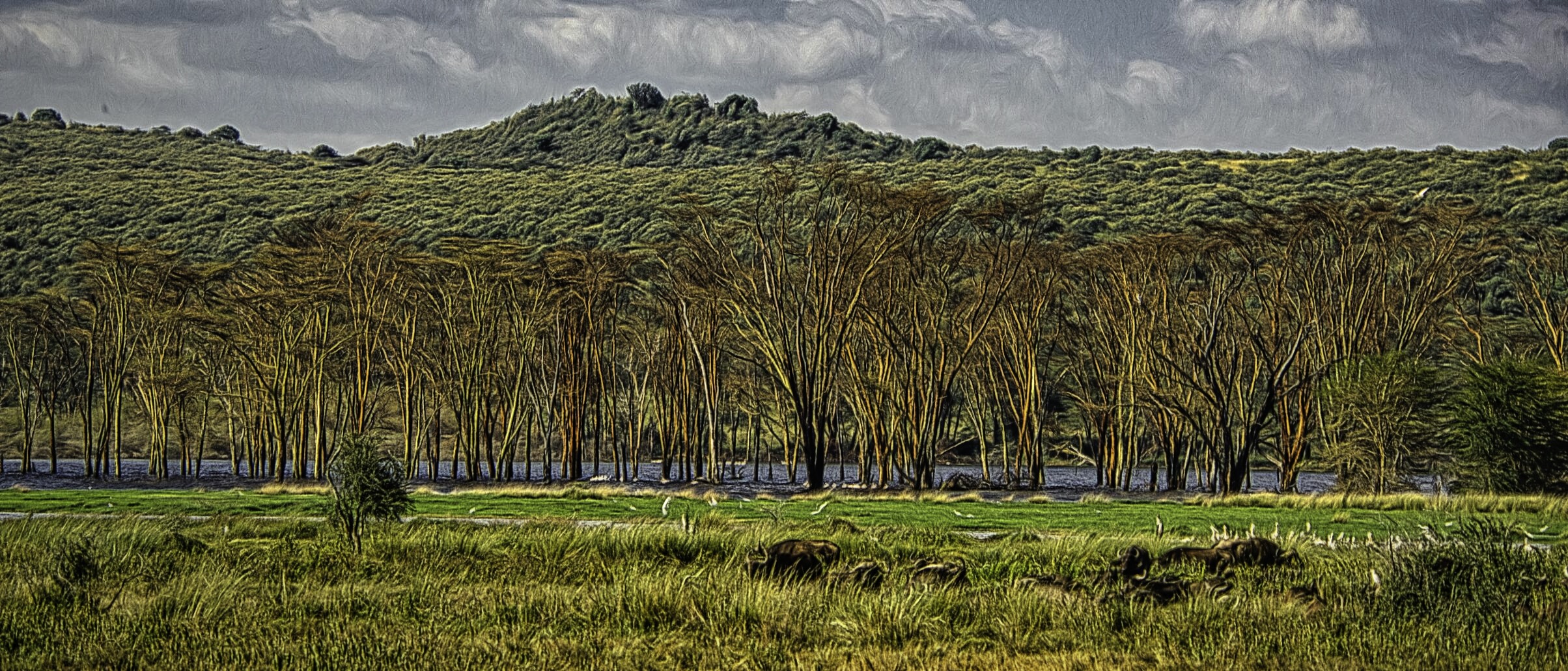
Our lunch stop was right by the entrance to Lake Nakuru National Park. When we entered the park, it didn’t take us long to get to the lake. Lake Nakuru is quite interesting in that it is continuing to enlarge by taking over more and more territory. It is being fed by an underwater spring. Along the edge of the lake where we entered are a lot of dead trees which died after the lake water surrounded them.
The lake also used to be a saltwater lake. However, the spring is changing it to more of a fresh water lake. That has caused the population to change. The lake used to be well known for its flamingo population. However, they survive best in salt water environments which provides their food source. As a result the flamingo population has diminished almost entirely. In a spot we visited later we saw about six flamingos. two of which were juveniles.
In the place of flamingos, the pelican population has taken over. We saw a lot of them as we entered the park. They were sitting on the branches of the dead trees or swimming together in groups searching for food. I had first seen pelicans in California when we visited the Channel Islands National Park. Along with the pelicans were the cormorants which were also thriving in this area.


We saw some other birds as well. This was when Rafael’s experience kicked in. We were driving along, and he spotted a small bird in a tree. How he spotted it while driving, I still don’t know. We chased it down the road a bit before it finally settled on a branch where we could take a photo. (the fourth picture below) We also saw eagles and a dark bird with a plume on its head. A stork also caught our attention later in the day. It was hard to remember all the names of the birds.


We continued along the water’s edge and eventually came to some buffalo. These are quite common in Lake Nakuru National Park. It was also common to see a large bird on their backs. The challenge in this park is finding the animals. Because there are now lots of trees and bushes, the animals have more places to hide and not be seen by those on a safari.
When we got to the end of the lake, we began to see other larger animals. We saw the ubiquitous zebras. We also encountered a herd of female impalas with their horned male leader.


Farther down the road we saw more buffalo, and one had a baby with her. Unfortunately the baby was so short that it usually disappeared into the grass. I never got a really good photo of it.
We drove back down towards the lake again passing a large herd of buffalo resting in the sun. The setting was really nice with interesting trees and nearby hills along with the lake.


At the lake a large colony of pelicans was hanging out by the water. This is where we encountered the flamingos. The ones with reddish legs are adults and the ones with black legs are juveniles. Other birds hung out here as well. It was definitely a birder’s paradise.


Driving down another road we encountered our first giraffes at Lake Nakuru. We noticed right away that the giraffes here were darker than the ones in Massai Mara. However, they were just as majestic as ever.


Nearby we saw our first rhinos. Rafael had said we would see some here so I think he was happy when we did. The only problem was they were pretty far away so we couldn’t see much detail. That didn’t stop me from snapping a lot of photos trying to see them better.


We passed a group of bachelor impalas and then came to another circle of life moment. On the ground we saw the large remains of a buffalo. Quite close by we saw a lioness resting behind a bush. She seemed to be alone. Farther down the road, however, there was a lone male lion. Unfortunately other vehicles were there, and we were in no position to really see him. I got a glimpse of his stomach, and that was about all.


We turned back on the road passing another beautiful giraffe. Baboons were our next encounter including a mother and baby. They were on the road, and the dust made them a little less visible.


Down the road we had our next encounter with a rhino. There were two this time, and we were closer so we were able to get better photos. They were walking around, and one of them appeared to be coming pretty close to us, but then it stopped. One of the things we learned was that there are two kinds of rhinos, black and white. However, both are grey in color. The differences involve more than color. Rafael explained the difference, but it was a lot to take in.


Moving on down the road, we had another encounter with a giraffe. There were a number of them along with some zebras. One of them came to the road like it wanted to cross to the other side. A line of safari vehicles was on the road where it wanted to cross. After looking at the vehicles for a moment, the giraffe then turned around and walk away and down the road behind our vehicle where it then crossed the road. It’s moments like that which show me that while the animals are wild in the park, they have had enough interactions with humans to respond to their presence much like the leopard had done a few days before.


We began to drive back towards the entrance of the park when Andrea spotted a rare sight. A hippo was grazing on the side of the lake. Hippos don’t usually come out of the water during the day time so seeing the large animals was an unexpected treat.
We also encountered some cute monkeys as well as more baboons. The bird in the photo is a stork.


The evening light made for some nice final photos of Lake Nakuru and its trees and wildlife.


It was a fairly long drive over to the lodge where we spent the night. Our room was not a tent and even had a second bedroom for Andrea. The resort was much smaller than the other resort. At dinner there were only about 20 people. We never really got a good look at the place as we arrived after dark and left very early the next morning due to a change in plans. More about the reason for that next week as the Kenya part of our summer adventure comes to a close.
What African animal would you most like to see on a safari? Let me know in the comment box below. I’d love to hear from you.
Discover more from Battered Suitcase
Subscribe to get the latest posts sent to your email.