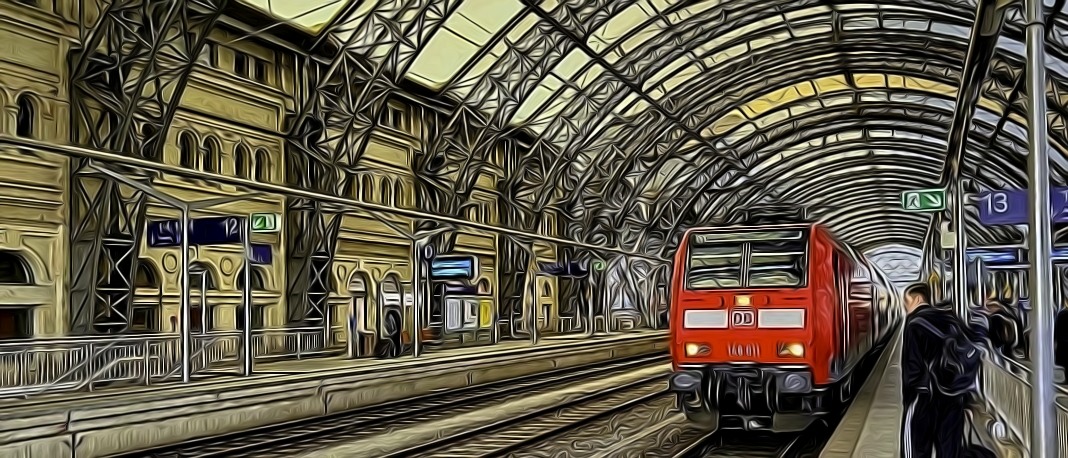
Train travel is very common in Europe. Since countries are so close to each other, it makes sense to travel these shorter distances by train. We have ridden the train on numerous occasions in Europe. I certainly don’t consider myself an expert on train travel. Nevertheless, I thought I would share some comments regarding train travel in general as I share about our trip by train from Dresden, Germany to Wroclaw, Poland.
Why travel by train? First it is often cheaper to travel by train than to fly. Secondly it is often quicker and easier. While the actual travel might be faster with flying, one needs to consider some of the other aspects. Most airports are on the outskirts of a city so one has to get out to the airport. Then one has to check in and go through security. Airlines usually expect passengers to be there at least an hour ahead of the scheduled departure. At their destination travelers may have to wait for their baggage and then travel back into the destination city. Put all this together, and flying can sometimes actually take longer.
What are some of the other benefits of train travel? Traveling by train seldom involves security lines. Only on one trip in Spain did we have any kind of a security check. Train stations are often in the center of town which can be more convenient for travelers. The seats on train are usually not as crammed together as they are on a plane. Finally you can carry all your luggage with you onto the train. That may be a bit challenging but can save time in the end.


If one is considering train travel, the easiest way to get a reservation is through an online website. In my experience most train lines don’t have their own reservation lines like airlines do. Most online companies will give you options which might include a number of different train lines.
Choosing your trip can require one to decide what is important. Is speed important? Look for trips with few stops. However, they might come with a higher price tag. What time do you want to arrive? When we booked our train from Dresden to Wroclaw there was one problem with the reservation we made. It arrived after dark. We didn’t like that, but otherwise it was our best option.
What made it the best option? Transfers. There is no direct line from Dresden to Wroclaw so we had to transfer to a different train. Some options offered had three transfers. Some offered transfers that would only have a 10 minute layover. We didn’t like that. On the other extreme were the transfers with layovers over an hour. The trip we booked had one 23 minute transfer. That we could handle.
Our transfer turned out to be in a small rural area. We arrived on one track and after our wait left on the only other track. There was no large station, and we were outside. Fortunately the weather was fine.


We had already ridden on a train earlier on this trip traveling from Berlin to Dresden. That trip went awry because of seat choice. When I made the reservations, I asked to have our seats in two rows facing each other perhaps with a table in between. This is a fairly common formation on trains. It allows a group to enjoy their conversations together. However, it’s not so comfortable an arrangement if you are sitting opposite of someone you don’t know.
For our Berlin trip we somehow ended up with four window seats so we were not even sitting on the same side of the train. We manage to trade a seat and make it work, but it was weird.
The other challenge with assigned seats is knowing where your seats are located on the train. Your ticket will give you the car number, but finding that car can be a challenge. That was a problem in Berlin. It was also a problem on our trip south in Portugal. On that trip it was hard to determine which car we were in because the numbers weren’t clear on the outside of the train cars.


One of the main anxieties of train travel is making sure you are on the correct train. No one checks tickets when passengers get on, and often there is no staff around to ask. (They will eventually check tickets on the train) Some of these stations have up to 16 train tracks coming into their stations. Travelers need to make sure they are at the right location to catch the train.
Actually one has to make sure they are at the right station. Some major cities have more than one train station. Brussels has three stations. When we traveled to Paris from there, only one of the stations had a train to Paris. It was a station we had not used before so we were a bit nervous, but we made it.
Most large stations have reader boards that give the information telling travelers which track their train is leaving from. Knowing your train number as well as your destination helps to make sure you are on the right track. Sometimes the trains come pretty close together so there is little time to dawdle and try to figure out if one is on the right train. In Dresden I ended up asking someone to make sure I was on the right track, and then I looked at the destinations on the reader board to make sure I saw the city I was traveling to. Fortunately all was well.


On our trip from Dresden we did not have assigned seats. Depending on when one gets on the train, that can be a good or bad thing. We got on at the beginning of the run so the train was pretty empty, and we were able to choose good seats. The same was true on the second leg of our journey. However, this leg had a lot of stops (I counted 24), and it gradually filled up. People who got on later didn’t necessarily have options of where to sit, and we finally had someone sit in our little section across from me. That felt a bit awkward.
Another obvious benefit of train travel is one gets to see some of the countryside up close. Not having been in Poland before, I was enjoying the forests we passed through as well as the fields of farm land. We passed through some quaint villages and some that had seen better days. As we got into Poland, we began to see more and more snow. It was also becoming foggy. Looking out the window, it seemed all we could see was white.
Our total time for the trip was over four hours. We arrived in Wroclaw around 4:00 which means it was already dark. Here things didn’t go as we had hoped. Our hotel was not in the town center as our other hotels had been. We had information on Google maps about what light rail to take to get to our hotel. We found the train line, but we didn’t see the stop we were looking for which made us nervous to get on. In the end we paid for a taxi to take us to out hotel. It was worth it for the lack of stress using the public transportation. Tomorrow when we can see things easier in the light of day, we will figure it all out.
Travel experts frequently mention traveling by train. it’s a good options, but it’s not without its challenges and anxieties. Hopefully my thoughts will help you if you plan to travel by train in Europe. If you are a seasoned train rider, feel free to share your thoughts and comments in the comment box below. I’d love to learn a few hacks myself. There are plans for more train travel this year. Next week I’ll introduce you to Wroclaw, Poland.
Credit: Most of the photos in this post taken by Silvette Lee
Discover more from Battered Suitcase
Subscribe to get the latest posts sent to your email.
Interesting article. Good info to know about the trains. You will have so many wonderful memories from all your exciting travels
Janie, thanks for your comment. Yes we do have a lot of good memories, and we are hoping to add even more this summer. Glad you can follow along.